
tictoc help business — why using tictoc can help your business grow in 2026 is one of the most important topics for WordPress site owners. Read on to learn how it works and what practical steps you can take today.
You can skyrocket brand awareness with tictoc’s short-form format, tapping viral reach and algorithmic amplification to win attention fast while keeping costs low; if mishandled, however, you risk public backlash from missteps, so smart, playful content and fast community engagement turn eyeballs into sales and loyal fans, giving your business a measurable growth edge in 2026.
Key Takeaways:
- Short-form video reach: algorithmic distribution surfaces content to broad, engaged audiences quickly, boosting brand awareness and driving conversions.
- AI-driven discovery and targeting: personalized recommendations and refined ad tools lower acquisition costs and improve campaign efficiency.
- Commerce and creator ecosystem: shoppable features and creator partnerships enable rapid product testing, authentic social proof, and scalable sales.
tictoc help business: The TikTok Phenomenon: Why Now?
From Dance Trends to Business Brands
You see the choreography, then you see the checkout cart – brands have learned to turn viral sounds into measurable sales. For example, e.l.f.’s “Eyes. Lips. Face.” campaign generated over 4 billion views, and Chipotle’s #GuacDance pulled in more than 250,000 user videos, translating directly into foot traffic and promotional lift.
Now you can copy that playbook: prioritize short, remixable content, partner with creators who already speak your customers’ language, and design assets to be reused by the community. That approach keeps production costs low and authenticity high, while features like in‑app shopping and live streams let you close the loop from discovery to purchase – a fast path to ROI that traditional ad funnels rarely match.
The Numbers Don’t Lie: User Engagement Insights
TikTok now exceeds 1 billion monthly active users, and people spend roughly an hour a day scrolling, which means your creative has multiple chances to surface. Brands typically see engagement rates that outpace other social platforms, often by a factor of two or more when content clicks with the algorithm and the audience.
The platform’s algorithm rewards watch time and rewatch behavior, so your first two seconds must hook viewers or the post dies fast. Use looping edits, sound-driven hooks, and native text overlays to boost completion rates – those behaviors directly translate into reach and virality, not just vanity metrics.
Digging deeper, combining organic creator-driven posts with targeted paid amplification is where you get scale: creators build trust and authenticity, while modest ad spend amplifies momentum into consistent reach and conversions, a hybrid strategy many brands have used to turn trend-driven exposure into repeatable sales events.
Targeting the Right Audience
Demographics That Matter in 2026
With TikTok now hosting over 1 billion monthly active users, you can’t treat it like a youth-only sandbox – although the platform still skews young. The largest single block remains the 18-34 cohort, which represents roughly half of active users, while the 25-44 segment has been the fastest-growing audience year-over-year as professionals and parents adopt short-form video for discovery and shopping. If your product targets discretionary spend (home tech, apparel, personal care), prioritizing the 25-34 and 35-44 slices will get you higher average order values than chasing impressions among teens alone.
Use TikTok’s built-in signals – age, device type, watch-time buckets and interest clusters – to slice your audience. Brands that combine demographic filters with behavior (for example, users who viewed “how-to” content for >50% of the video or engaged with product-review creators) typically see stronger conversion lift than campaigns based on age-only targeting. Targeting by household-behavior proxies and watch-time segments is where you convert passive scrollers into buyers.
Niche Marketing: Finding Your Tribe on TikTok
Hunting for your niche starts in the hashtag depths and creator rosters: map 8-12 niche hashtags, follow 20-30 creators who post consistently, and monitor the comment threads – that’s where communities reveal themselves. Big-brand examples prove the point: e.l.f.’s music-driven campaign exploded because it tapped a specific content style and community behavior, and fitness brands like Gymshark scaled by partnering with micro-creators who owned smaller, highly engaged tribes. For you, that means choosing creators with audience alignment over vanity follower counts.
Operationally, prioritize micro-influencers (typically 10k-100k followers) for testing – they usually deliver higher engagement rates and authentic creative at a lower cost than macro influencers. Run quick A/B tests across three creative angles for each niche (tutorial, review, lifestyle) over 7-14 days, then scale the top performer with Spark Ads or In-Feed promotions. Micro-creator + niche-hashtag combos often produce the best ROI because the algorithm rewards authentic engagement and watch time.
Double down on community signals once you find traction: create a series format, seed UGC challenges, and set up creator-led Q&A or live sessions to deepen affinity. When you treat each niche as its own small market – with tailored CTAs, pricing, and shipping promotions – you turn algorithmic boosts into sustained sales, not just viral vanity metrics.
The Power of Short-Form Content
Attention Spans Are Shrinking: Adapt or Perish
You’ve got to grab attention in the first beat – most social feeds reward early engagement, so if you don’t hook viewers in the first 1-2 seconds, they’ll swipe past. Platforms like TikTok and Instagram rank content by watch-through and early engagement signals, which means that a punchy first frame, bold caption or an immediate visual surprise directly translates into higher distribution and lower CPMs for ads.
Test aggressively: run variants with different 0-2 second hooks and measure the 3‑second and 6‑second view rates to see what actually stops scrolls. Brands that segment creative (brand-first, product-first, humor-first) and optimize toward the highest early-retention clips typically see better conversion per dollar than brands that build long, explanatory intros.
Creativity on a Time Limit: The Art of 15 Seconds
You must treat 15 seconds like a mini-campaign: one clear idea, one emotional beat, one action. Advertisers and creators are converging on the 6-15 second sweet spot because it forces clarity – shorter formats increase shareability and completion rates, which boosts algorithmic reach. Use bold visuals, a single voiceover line, or a striking value proposition and the platform will do the heavy lifting.
Borrow tactics from viral creators: lean on a repeatable visual motif, a trending sound, or a quick before/after that communicates benefit in a glance. For example, a SaaS company can show a 10‑second screen clip solving a common pain point, then a 3‑second overlay with a free-trial CTA – low friction, high intent.
Structure your 15 seconds like a funnel: 0-2s hook, 3-8s demonstration/value, 9-12s social proof or reassurance, 13-15s clear CTA. When you script and storyboard to these micro‑beats, you stop wasting impressions on vague setups and start turning short views into measurable actions.
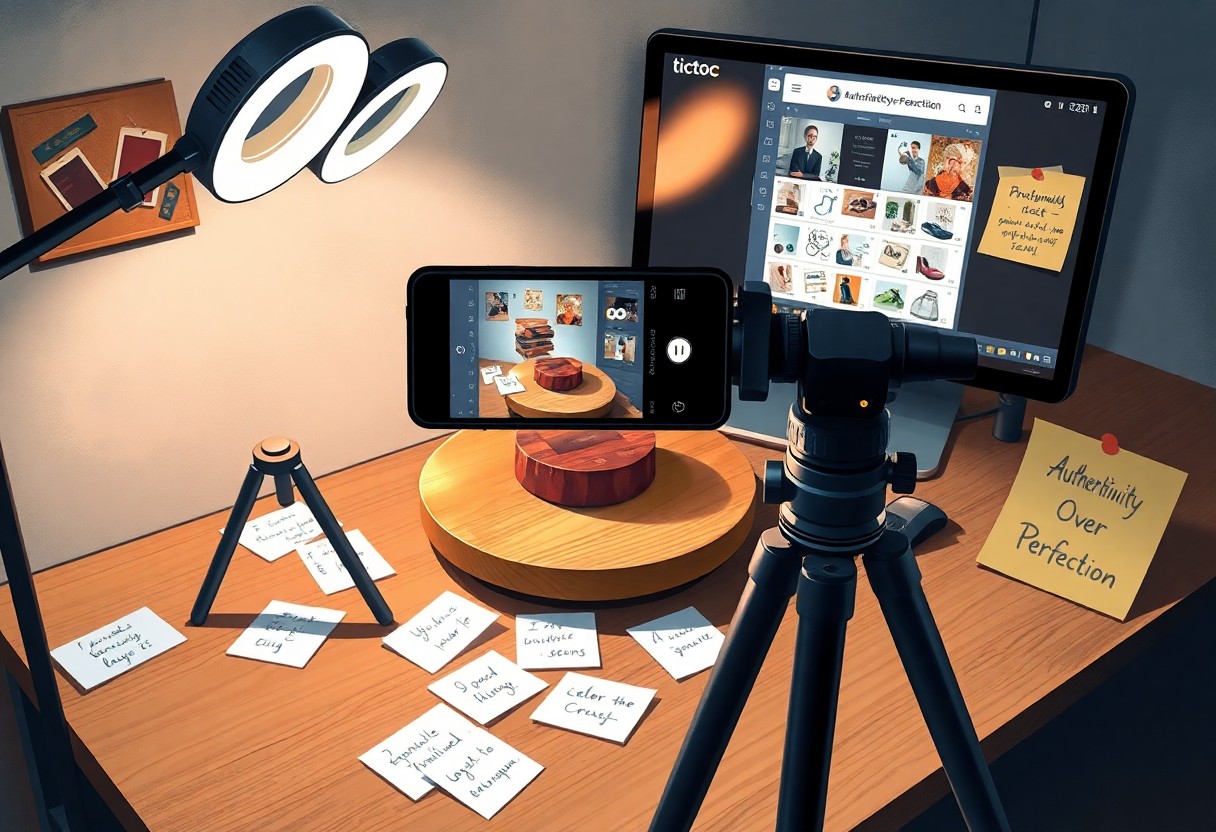
Authenticity Over Perfection
The Rise of Realness: How Authentic Content Wins
Your audience trusts people who look like people – not glossy ads that could double as stock footage. On TikTok, unscripted clips and behind-the-scenes moments routinely outperform polished spots because they drive longer watch times and higher engagement; many brands report completion-rate lifts in the range of 20-40% after shifting to raw, candid content. Use that: short, vertical takes that show real use, accidental flubs, or authentic reactions keep viewers watching and signal the algorithm to push your content further.
Embrace imperfection as a tactical advantage: film product demos with natural lighting, capture customer reactions in one take, or let creators ad-lib a 15-30 second riff. Brands like Chipotle and Gymshark scaled visibility by leaning into creator spontaneity and community-driven formats – that means you should prioritize repeatable, real moments over single high-budget productions if you want consistent reach and conversion.
User-Generated Content: Your Customers as Marketers
UGC converts because people trust peers more than brands: studies show consumers are more likely to buy after seeing authentic customer content, and many companies report conversion lifts of 10-30% when UGC is used in funnels. Start by creating simple prompts – a 20-second challenge, an unboxing template, or a “how it fits” request – then incentivize submissions with discounts or features; that approach turns your community into a scalable content engine with minimal agency spend.
Paid amplification of UGC is efficient: when you run ads that are literal customer videos, you often see lower CPMs and higher CTRs compared with branded creative, because the ad feels native to the platform. Operationally, tag and credit creators, compile short testimonial montages for product pages, and rotate the strongest clips into your ad sets to keep authenticity high while testing which voices drive performance.
Don’t ignore the legal and measurement side: get written permission before republishing, store rights in an organized asset library, and track UGC-specific KPIs like hashtag reach, share rate, and sentiment. Scale by partnering with micro-influencers (5k-50k followers) who often deliver the best combination of authenticity and cost-efficiency, and set a simple brief – vertical, under 45 seconds, natural audio, on-brand hook in the first 3 seconds – so creators know exactly what you want without killing the vibe.
Trends and Challenges: The Ever-Evolving Algorithm
Understanding Viral Trends: Catching the Wave
When you spot a rising trend, speed matters: many trends on tictoc spike and start fading within 48-72 hours, so converting the idea into your own content during that window often determines whether you ride the wave or watch it pass. Use a trending sound or format but give it a brand-specific twist – for example, swap the choreography for a product reveal or turn a meme template into a how-to; creators who adapt rather than copy tend to get both reach and trust.
Actively monitor creator discovery (the For You-like feed and trending tabs) and prioritize experiments over perfection: try short-form tests of 15-30 seconds with a hook in the first 2 seconds, then double down on the picks that get higher rewatch or share rates. Small creators and micro-influencers often seed trends, so collaborate early – partnerships with accounts in the 10k-100k follower range commonly deliver higher engagement rates and faster momentum than waiting for a mega-influencer to pick up your idea.
Algorithms Demystified: How to Stay Relevant
Algorithms on tictoc work like iterative A/B tests: your post is shown to a batch of users, and if it yields strong signals (watch time, completion, rewatch, shares, and follows after view) the platform scales distribution to progressively larger audiences – typically from a few hundred to a few thousand users in early tests. That means small changes to the opening seconds, caption, or thumbnail can dramatically change outcomes, so treat every upload as an experiment and track the first-hour performance closely.
Practical levers you can pull include optimizing for retention (structure content to encourage loops), using clear on-screen captions for sound-off viewers, and leveraging trending audio or hashtags while keeping on-brand. Posting cadence matters: many brands test 3-5 posts per week to balance reach with production capacity, while top creators often post daily; use analytics to identify the posting windows that deliver the best initial engagement for your audience.
Measure and iterate with specific KPIs: watch retention curve, rewatch rate, click-through, and conversion events, then allocate ad or boost spend to the top 1-3 performers – a common rule is to dedicate about 20% of your content budget to promoting winners. If a creative holds above 50% retention at a key timestamp (for instance, 15 seconds in a 30-second clip), treat it as a scaling candidate and test variations (different captions, CTAs, or crop formats) to squeeze more reach.
Paid Promotions and Collaborations
Influencer Partnerships: The New Word of Mouth
You should prioritize micro-influencers (10k-100k) for targeted engagement – they often deliver engagement rates in the 2-8% range and charge between roughly $100-$1,000 per post, while macro creators trade reach for cost (think $5k-$50k+ per placement). Use tiered campaigns: seed with 20 micro-creators for authenticity, amplify 3 proven posts with paid boosts, and scale one breakout creator to drive reach; brands that pair this approach report better engagement per dollar than pouring budget only into big names.
Structure deals around performance where possible – trackable promo codes, affiliate links, or CPC-based clauses – and insist on content ownership or a clear license if you plan to reuse the asset. Vet creators for audience quality to avoid fake followers and brand-safety risks, and include FTC disclosure and a short creative brief so the content feels native to the creator while still hitting your KPIs.
Ads That Don’t Feel Like Ads: Creative Ad Strategies
Native, creator-backed formats win: use boosted organic posts, Spark Ads, or in-feed UGC to match users’ feed patterns instead of interrupting them. Brands like e.l.f. proved this by seeding an original track and creator content that turned into a viral trend – the campaign drove billions of views and massive lift in brand awareness – showing that an authentic sound and creator-first approach can out-perform polished commercials.
Test aggressively: run 2-3 creative variations per ad group, optimize for the first 1-3 seconds hooks, and compare 15s vs 60s cuts. Measure CTR, view-through rate, and ROAS by campaign, and shift budget to the combinations that lower CPA; many marketers see CAC drop when they favor native creative and creator amplification over traditional production-heavy spots.
Operationally, buy or license raw creator footage so you can A/B it as scalable assets – paying a creator ~$500 for vertical, sound-on footage and then boosting it can often beat a single polished $5k spot in CPA. Keep a rolling library of creator clips, tag them by performance, and rotate assets weekly to avoid ad fatigue while preserving that “not-an-ad” feel.
Measuring Success: Analytics and Adaptation
Key Metrics for TikTok Triumph
You should track average watch time and completion rate first-TikTok rewards videos that keep viewers watching, so a completion rate above 50% or an average watch time that approaches the full clip dramatically increases organic reach. Also monitor engagement rate (likes+comments+shares divided by views or followers), where a solid benchmark is often in the 3-9% range depending on niche; anything above that signals content worth scaling.
Include ad-specific KPIs too: CTR for in-feed ads (aim for about 1-2%+ as a starting target), conversion rate on your landing pages, and ROAS for paid campaigns. Use cohort analysis-compare performance by creative, posting time, and audience segment-and you’ll spot which variables move the needle: a DTC brand that segmented by hook increased conversion rate from 1.2% to 2.6% after three weeks of testing.
Adapt and Evolve: The Continuous Growth Mindset
You’ll want a rhythm of rapid experiments: run 4-6 new clips each week, keep a simple spreadsheet of metrics, and double down on the top 10-20% performers. Tools like TikTok Analytics, Creator Marketplace and third-party dashboards show you where views come from, which sounds and hooks trigger rewatches, and which audiences convert-use that to pivot within 7-14 day windows rather than waiting months.
Make iterative creative the rule: test verticals (edu, behind-the-scenes, UGC), trim or extend length (10s vs. 30s), and swap CTAs; small changes can flip performance-one apparel brand shaved 5 seconds off intros and saw a 35% lift in completion and a subsequent 22% increase in add-to-cart events. Treat paid and organic learnings as shared assets so learnings compound across channels.
For more tactical clarity, set a rolling 30-day experiment plan: pick one primary KPI (watch time or CAC), run three creative hypotheses against identical audiences, and allocate budget proportionally to early winners; this disciplined loop often cuts CAC by 20-40% within a month while increasing your hit-rate for scalable creatives.
To wrap up
Conclusively, using tictoc in 2026 turbocharges your growth by placing your brand where attention lives: bite-size videos that turn casual scrollers into customers and an algorithm that rewards creativity and velocity. You can test ideas overnight, double down on winners, and outpace competitors who are still drafting long-form campaigns.
Plus, tictoc’s commerce tools and creator ecosystem let you plug into influencer momentum, launch micro-campaigns, and track results in near real time, so your creative risks become data-driven wins. Lean into trends, keep your content nimble, and you’ll scale smarter – faster visibility, deeper engagement, and better ROI for less fuss.
FAQ
Q: How can using tictoc increase my brand’s visibility and customer acquisition in 2026?
A: tictoc’s short-form video-first feed and algorithmic discovery prioritize fresh, engaging content, making it easier for brands to reach new audiences without huge ad budgets. Trends and challenges drive organic virality, while creator collaborations amplify reach quickly; combining organic posts with targeted ad campaigns converts that attention into measurable customer acquisition across demographics and regions.
Q: What features on tictoc help improve engagement and conversion for small businesses?
A: Native shoppable formats, live commerce tools, interactive stickers and AR experiences turn viewers into buyers inside the app, shortening the path from awareness to purchase. Built-in creator marketplaces and duet/remix features make user-generated content scalable, and strong community features (comments, DMs, saved collections) increase repeat engagement and lifetime value.
Q: How do tictoc’s analytics and advertising tools support measuring ROI and scaling marketing in 2026?
A: tictoc provides real-time performance metrics, AI-driven audience insights, and predictive creative testing to optimize spend and lower acquisition costs. Robust ad targeting with privacy-first first-party signals, easy CRM and commerce integrations, and automated bidding let businesses iterate quickly, attribute conversions accurately, and scale campaigns based on clear ROI signals.